Nineteenth Century American Flutes and Their Music (Part I)
by Wendy Werstuik
On April 2, 1800, Beethoven’s First Symphony premiered at the Hoftheater in Vienna. Featured in a public concert program organized by the composer himself, the flute part of the First Symphony stayed in a comfortable range and keys for the instrument. Over the next half of the century, orchestral flute music in continental Europe would undergo significant transformations that pushed the limits of the instrument to an extent never seen before. The “Viennese flute”, as it came to be known, was developed to meet such musical demands as laid out by Beethoven and his contemporaries. A 13-key flute from Johann Joseph Ziegler’s workshop in Vienna in The Greenleaf Collection is a prime example that showcases the technical sophistication and craftsmanship of Viennese woodwind instrument makers in mid-19th century:

1858-1878, Ziegler, 13-key Flute with B Foot, from The Greenleaf Collection
Across the English Channel, the transverse flute, known as the German flute (a nomenclatural tradition passed on from the French), continued to be adopted by professionals while gaining ground as a favorite pastime of the gentleman amateur. Settlers from England and Continental Europe brought the German flute to the New World as early as the 1700s, and by 1834, the number of amateur flute players in New York were “numerous”, according to the American Musical Journal published that year:
Music is cultivated privately to a great extent; almost all parents consider it a necessary accomplishment for their children; every house of respectability has its piano, guitar or harp, and music is the chief source of amusement at our social meetings. The amateurs of the flute, violin and other instruments were numerous, and many of them have achieved considerable proficiency.1
The 19th century was a knotty time for the transverse flute. The revolutionary Boehm flute would be invented in this century, yet old designs from the Baroque simultaneously persisted, not as a blast-from-the-past but a consistent presence that never disappeared from the scene. Plenty has been written about the first Boehm system flute made in the United States, but questions linger as to who might have manufactured the first German flutes domestically, and what prompted them to do so. Evidence abounds that instruments were built in the Colonies by early settlers as early as the 1600s. Specifically for flutes, probate court and town records suggest that Arthur Clarke (d. 1665) and John Dyer (d. 1696), both of Boston, made keyless flutes, either fifes or in the Renaissance style (Lambert). These keyless instruments were made either out of wood or metal, with Clarke being a woodworker and Dyer an ironmonger, and did not require sophisticated design specifications. They served either in military functions or private entertainment.
The addition of a key, traditionally credited to Louis XIV’s court (either Hotteterre or Philidor), profoundly changed the tonal possibilities of the transverse flute and began its first step toward becoming a truly chromatic instrument. Not much is known about domestic woodwind making in early 18th century American Colonies, though instruments of all kinds were continuously being imported or brought to the New World. As illustrated by an advertisement placed in the Boston News Letter in 1716:
This is to give notice that there is lately sent over from London a choice collection of musickal instruments, consisting of flaguelets, flutes, haut-boys, bass-viols, violins, bows, strings, reeds for haut-boys, books of instructions for all these instruments, books of ruled paper. To be sold at the dancing school of Mr. Enstone in Sudbury-Street near the Orange-Tree Boston. Note. Any person may have all instruments of musick mended, or virgenalls and spinnets strung and tuned at a reasonable rate, and likewise may be taught to play on any of these instruments abovemention'd; dancing taught by a true and easier method than has been heretofore.2
As one-keyed Baroque flutes made their way from France across the Channel and became popular during this period in England, it is reasonable to assume that they soon appeared on American soil. The first known mention of the term “German flute” in the Colonies appeared in an advertisement in the New York Weekly Journal on Jan 12, 1736 for a concert featuring Charles Theodore Pachelbel, a son of the famous composer Johann Pachelbel:
On Wednesday the 21st of January instant, there will be a consort of musick, vocal and instrumental, for the benefit of Mr. Pachelbel. The harpsicord part perform'd by him self. The songs, violins and German flute by private hands. The concert will begin percisely at: 6 o'clock. In the house of Robert Todd Vintner. Tickets to be had at the Coffee-House, and at Mr. Todd's at 4 shillings.3
A composer and keyboardist himself, the young Pachelbel was among the earliest musical celebrities to have emigrated to the New World. Having arrived in Boston in 1733, the concert he gave in 1736 was the first public concert on record in New York. When Pachelbel sought new opportunities in Charleston the following year, German flutes for sale began to appear in local newspapers there:
Lately imported and to be sold by Watsone and McKenzie, at their store on the Bay, opposite to Elliot's bridge, viz. garlix, white and brown hollands, cambricks, . . . [14 lines, housewares] glass and earthenware, German flutes with mouth-pieces and books for learners, bureaus, brushes, brooms, corks, . . .4
The “private hands” in the 1736 advertisement are understood to be amateur players, and it is unclear whether the instruments played were brought by settlers to the Colonies directly or purchased domestically (most likely of English import). Nonetheless, it is evident that by mid 1700s, professional performances of the German flute were heard in places like New York:
For the benefit of William Cobham and William Tuckey, on the 29th instant, will be a concert of vocal and instrumental musick, to be performed at the new-exchange, viz. The celebrated dialogue between Damon and Chloe, composed by Mr. Arne; a two-part song, in praise of a soldier, composed by the late famous Mr. Henry Purcil; and an ode on masonry, accompanied with instruments, never performed in all its parts, in England, but once. A solo on the German flute, by William Cobham. Tickets will be ready by the 12th instant, and may be had at the house of William Cobham in Hanover- Square; and at the King's Arms.
N.B. After the concert there will be a ball for the ladies, to begin at 6 o'clock precisely.5
It is interesting to note that while the early American fife makers were natively born, the initial champions of the German flute were almost exclusively immigrants. The influx of new arrivals from Western Europe in the first half of the 18th century to urban centers like Philadelphia brought new skills to the New World, including instrument making. Born in Germany, Gottlieb Wolhaupter, who is often believed to be the first oboe maker in the Colonies, was advertising German flutes and other woodwind instruments of his own making in New York by 1761. Jacob Anthoy, also of German origin, arrived in Philadelphia around 1764 and set up his own woodwind shop there with his son. The pair continued operation into the 19th century. Even though Anthony appears to have arrived in the Colonies a few years later than Wolhaupter, none of the Wolhaupter flutes has been discovered to date. As such, two flutes from the Anthony workshop remain the earliest surviving domestically produced German flutes. They are housed at the Library of Congress as part of the Dayton C. Miller Collection.
Woodwind manufacturing continued to flourish after the Revolutionary War with clusters of manufacturing centers all around the original Colonies, including Boston, Philadelphia, New York City, Albany, and Hartford, Connecticut. If domestic productions complemented British imports before the turn of the 19th century, the Embargo Act of 1807 significantly curtailed all foreign trades and gave a decisive boost to the establishment of American woodwind manufacturing. (When trade finally resumed after the War of 1812, woodwind imports were subject to a 30 percent tariff.)
London, a center for woodwind innovation by the start of the 19th century, supplied the new republic with the latest technologies. One such London transplant, Edward Riley, arrived in New York in 1805 and shortly after began to operate as a music publisher, teacher, and instrument manufacturer. Having come to the right place at the right time, Riley became highly successful. Two of his associates, John Firth and William Hall, who both served in the United States military during the War of 1812 and would later become brothers-in-law through marriages to Riley’s daughters, struck out on their own after working in Riley’s shop (Dobbs). Both immigrants themselves, Firth and Hall joined forces in 1821 and established Firth & Hall in New York City, continuing along the same business lines as Riley.
Meanwhile, about 100 miles north of New York City, a separate cohort of woodwind makers grew out of Hartford, CT, at the helm of which was George Catlin. Unlike Riley, Catlin was a fifth generation American and a native of Connecticut. Though the New England Puritans adhered to strict regulations on instrumental music during church services, secular music played a key role in social settings. Beginning around the turn of the 19th century, Catlin manufactured a variety of high-quality musical instruments “unsurpassed by any American maker of that time and compared well with European instruments” (Eliason). While it is not known where Catlin may have acquired his manufacturing skills, he did appear to have trained several others who went on to become notable early American woodwind makers themselves. The Meacham brothers, who began in Hartford and later moved to Albany, NY, possibly apprenticed under Catlin and who later may have provided training to William Hall.
Among the finest woodwind makers at the time, the Meachams were responsible for the earliest American made oboe discovered to date and produced several five-key clarinets that survived to this day, one of which is housed in The Greenleaf Collection. While conflicts and trade restrictions prevented imported goods from reaching American shores thereby expediting domestic woodwind production, they also stalled the import of the newest ideas. As a result, American makers like the Meachams continued to make one-key flutes (and five keyed clarinets) while elsewhere, the instrument underwent significant improvements and innovations such as those pioneered by Richard Potter in England, including the addition of several keys.
In 1828, the Meachams were joined by Sylvanus Pond and thus began the partnership of Meacham & Pond. Little is known of Pond, aside from the fact that he was born in Milford, MA in 1792 and operated a music and military goods store in Albany in the early 1820s. Pond’s arrival brought more advanced key mechanisms to the Meacham productions (Eliason). However, the firm of Meacham & Pond was short-lived, for after only four years in partnership, Pond left Albany in 1832 to join Firth & Hall in New York.
One surviving flute from this short period is a one-key boxwood instrument owned by Henry David Thoreau and his brother, John, and is housed at the Concord Museum in Massachusetts.6 The flute features prominently in just about all of Thoreau’s writings and is a central part of the image of the writer’s life in the woods. For example, in Walden:
“In warm evenings I frequently sat in the boat playing the flute, and saw the perch, which I seemed to have charmed, hovering around me, and the moon travelling over the ribbed bottom, which was strewed with the wrecks of the forest.”
That Thoreau was a flute playing Pan of the Woods was immortalized in the poem “Thoreau’s Flute” by Louisa May Alcott. There is very little source that could point to what kind of music Thoreau might have played, aside from the apparent improvisation, if not primitively, and whether he had received any formal musical training. The possession of the Albany production by a Bostonian family does seem to suggest that Meacham & Pond gained popularity outside of the firm’s immediate locale and the regions along the Hudson River and the Erie Canal. Pond’s contribution to the design of this instrument is evident in the inclusion of four keys.
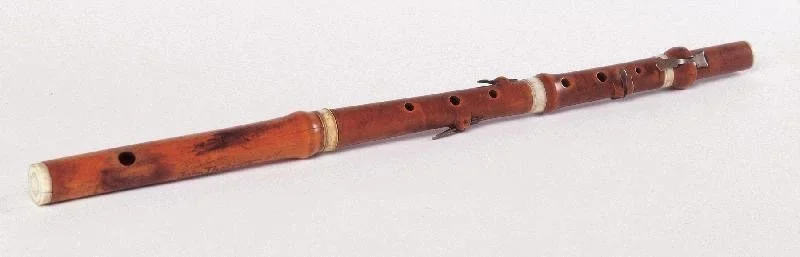
Flute, Meacham and Pond, Albany, NY, 1828-1832. Concord Museum Collection, Gift of Mr. Walton Ricketson and Miss Anna Ricketson; Th40. Image Courtesy of the Concord Museum.
While in Albany, the Meachams competed directly with Louis Alexander Peloubet, the father of the better-known Chabrier Peloubet. Louis Alexander immigrated to New York City in 1803 from France by way of Germany, to which he escaped after imprisonment during the French Revolution for fighting with the king’s army. Louis Alexander acquired woodwind making skills during his stint in Germany, which provided the livelihood for his family as they settled around the Hudson Valley, and which he passed down to his son. Chabrier Peloubet returned to New York City in 1829 and continued the family business (relocated to Bloomfield, NJ after 1836) until around 1881. Over a dozen flutes stamped with “C. Peloubet” are known to have survived, and they are generally considered fine specimens of 19th century American simple system flutes. In 1847, Peloubet entered three German flutes and one piccolo to the Fifth Exhibition of the Massachusetts Charitable Mechanic Association of Boston. As confirmed by a judgement from the award committee, these instruments were superb by contemporary standards as well:
“These instruments were exceedingly well made, in good tune, and very easy to be filled, answering promptly and readily to the most rapid fingering. The tone was clear and fine, particularly on the lower notes.” (Kaufman)
In The Greenleaf Collection is a four-key C. Peloubet flute from the Bloomfield factory. As can be seen by the wear marks around the embouchure and the finger holes, this was a well-used instrument:

1836-1849, C. Peloubet, 4 Key Flute, from The Greenleaf Collection
Comparing to a London instrument by H. Wrede in the Collection from the same period:

1837-1840, H. Wrede, 4 Key Flute, from The Greenleaf Collection
As almost all antebellum era flutes were imported from London, flutes initially manufactured on American shores were exclusively British in design. We notice, however, that as the mid-century approached, the American flute developed a few distinct features away from its London counterpart. One of the most recognizable American traits is the double ivory ring, as seen above in the Peloubet and absent in the Wrede. Additionally, the baroque style turning evident in the Wrede was done away with in the Peloubet (notice that turnings were still present in Thoreau’s flute made by Meacham & Pond, about a decade or so earlier than the Peloubet). If these features are purely aesthetic ones, the tapering of the flute—difference in diameter between the two ends—became more pronounced on the American instrument, and the tone holes also became slightly larger.
The partnership of Firth Hall & Pond lasted until 1847, when William Hall left with his son to start Hall & Son and specialized in piano manufacturing. From 1848 to 1863, Firth Pond & Co. operated as a music publisher, instrument manufacturer and dealers. The firm produced large quantities of instruments during this time, including simple system flutes mainly supplied to the amateur market, as well as pianoforte as per the trend of the time. Within The Greenleaf Collection are two one-key flutes by Firth Pond & Co.:

1847-1863, Firth, Pond & Co., 1 Key Flute, from The Greenleaf Collection

1847-1863, Firth, Pond & Co., 1 Key Flute, from The Greenleaf Collection
Though similar in appearance at first glance, the second flute is quite a bit shorter than the first, coming at 44.3cm in sounding length, vs. 52.8cm of the first one that is more typical of an American conical simple system flute. The difference in bore length is indicative of the varying pitch standards at the time.
Perhaps the most profitable of the Firth Pond & Co. endeavors was the role the firm played as the publisher of Stephen Foster. A flute player himself, Foster stands uncontested as America’s foremost song writer of the 19th century. His works reached every corner of the land and influenced such luminaries as Antonín Dvořák. A surviving flute that belonged to Foster is currently housed at the Stephen Collins Foster Memorial in Pittsburgh:
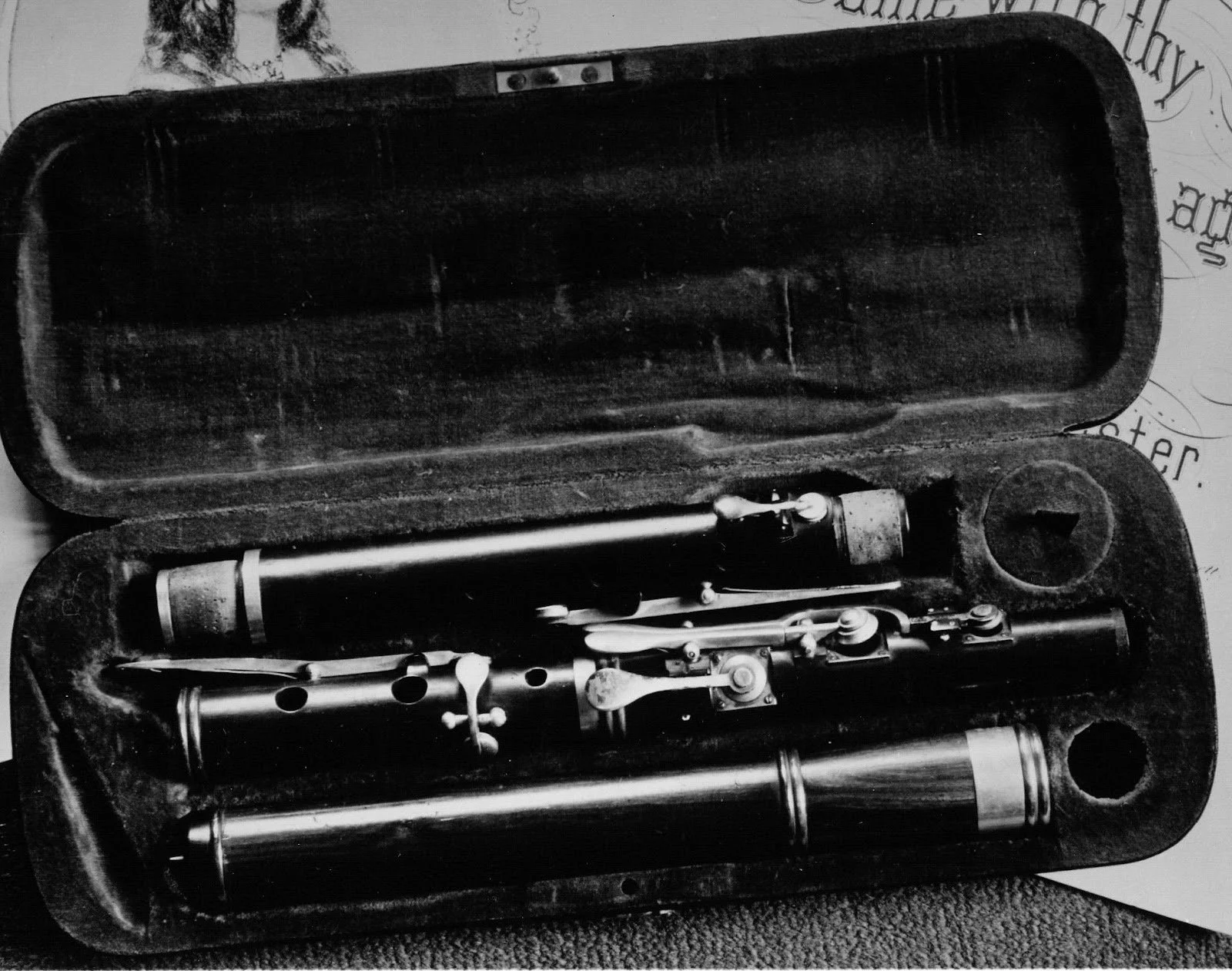
Foster Hall Collection, Center for American Music, University of Pittsburgh Library System.
Interestingly, this eight-key instrument was made by C. Peloubet, believed to be around 1850, and according to one account in 1984, this instrument “brings to thirteen the number of Peloubet flutes known to have survived” (Gangewere). The other 12 flutes were documented as two in the Smithsonian Institution, six in the Library of Congress, two in the Henry Ford Museum, and two in private collections. They do not include the four-key flute in The Greenleaf Collection mentioned earlier.
In addition to songs, Foster composed large collections of instrumental chamber music that features the flute. Together with other tune books from the 19th century, they shed light on the flute’s social role and help explain the persistence of the simple system instrument long after the Boehm flute had reached America. We shall explore that next.
The second installment, titled “Nineteenth Century American Flutes and Their Music (Part II)” by Wendy Werstuik, will be coming soon! Sign up for updates on our Contact page.
About the Author
Wendy Werstuik is a flutist and independent musicologist who studies the intersections between music, science, and intellectual history. Her work investigates the evolution of wind instruments in the context of scientific progress and social transformation, combining technical analysis with humanistic themes. An amateur painter with a keen interest in ballet—strictly as a spectator—Wendy delights in the elucidation of musical elements rooted in other art forms.

Notes
1“On the Evidences of Musical Taste”. American Musical Journal (Oct 1, 1834)
2Boston News Letter (April 23, 1716)
3New York Weekly Journal (Jan 12, 1736)
4South Carolin Gazette (April 30, 1737)
5New York Mercury (Dec 8, 1755)
6http://www.concordcollection.org/mDetail.aspx?rID=TH40&db=objects&dir=PERMANENT
Works Cited
Dobbs, Wendell. “An Early American Family of Flutists.” The Flutist Quarterly (Fall, 2008).
Eliason, Robert E. “George Catlin, Hartford Musical Instrument Maker, Part I.” Journal of the American Musical Instrument Society (1982).
—. “The Meachams, Musical Instrument Makers of Hartford and Albany.” Journal of the American Musical Instrument Society (1979).
Gangewere, R. J. “Stephen Foster's Flute.” Carnegie Magazine (June, 1984).
Kaufman, Charles H. “Musical-Instrument Makers in New Jersey 1796-1860.” Journal of the American Musical Instrument Society (1976).
Lambert, Barbara. “Social Music, Musicians, and Their Musical Instruments in and Around Colonial Boston.” Massachusetts, Colonial Society of. Music in Colonial Massachusetts 1630-1820 II: Music in Homes and in Churches. 1985. 407-514.
Rhoads, Kenneth W. “Thoreau: The Ear and the Music.” American Literature (vol. 46, no. 3, 1974): 313-28.
Taricani, Jo Ann. “Music in Colonial Philadelphia: Some New Documents.” The Musical Quarterly (vol. 65, no. 2, 1979): 185-99.
Article last updated: January 2026